Categories
Tags
Posted by News Editor
34 views
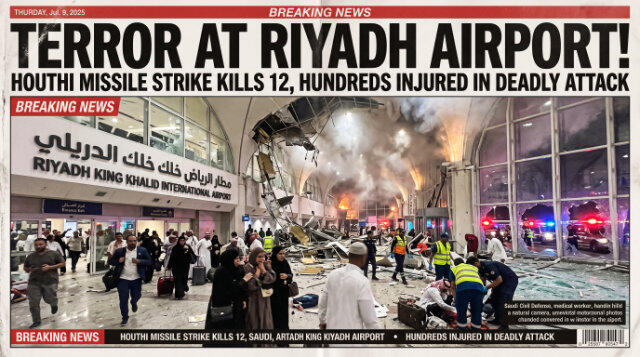
Riyadh Airport Hit in Deadly Escalation
A missile and drone strike targeting Riyadh’s King Khalid International Airport has killed at least 12 people and injured more than 300, marking one of the deadliest cross-border attacks on civilian infrastructure inside Saudi Arabia. The blast ripped through domestic terminal areas, collapsing ceiling sections and showering waiting travelers with shrapnel and shattered glass. Saudi civil aviation officials confirmed the casualties included both Saudi citizens and foreign nationals, with several victims in critical condition. Operations at the kingdom’s primary international gateway were halted as flights diverted across the region.
The attack comes amid an intensifying offensive between Saudi-led coalition forces and the Iran-backed Houthi movement in Yemen. Saudi authorities condemned the bombardment as a war crime, vowing a decisive military response after a week of repeated aerial attempts aimed at airports, military bases, and energy corridors. International leaders issued immediate alarms; the U.S. confirmed an American citizen was among the fatalities, while Washington indicated it is evaluating whether to join coalition combat operations against Houthi positions.
What This Means for the Region
Collapse of De-escalation: The strike shatters fragile diplomatic efforts to formalize a permanent Yemen ceasefire, pulling Riyadh back into direct, large-scale confrontation with northern Yemen.
Aviation & Economic Disruption: Commercial carriers face acute airspace risks across the Arabian Peninsula. Flight suspensions, surging insurance premiums, and threats to Gulf transport hubs jeopardize regional tourism and investment initiatives central to Saudi economic diversification.
Potential Western Military Intervention: Direct strikes on a major capital hub—coupled with international casualties—drastically increase the likelihood of coordinated retaliatory air campaigns by coalition and Western naval forces against launch sites, command hubs, and maritime supply chains.
Deepening Proxy Strains: The attack underscores advanced ballistic and drone capabilities supplied to the Houthis, heightening confrontation between Gulf states and Iran while threatening commercial shipping lanes across the Red Sea and Gulf of Oman.
The escalation in Houthi long-range strikes against deep Saudi civilian and transport infrastructure—culminating in the deadly strike on Riyadh’s King Khalid International Airport—directly spills into the maritime domain. Rather than an isolated cross-border air campaign, this marks a coordinated, two-front pressure campaign linking interior infrastructure disruption with maritime chokehold tactics across the Bab el-Mandeb and the southern Red Sea.
Red Sea Shipping Dynamics
Expanding Maritime Threat Perimeter: By hitting deep targets in the Saudi interior while consolidating coastal footholds along Yemen's Red Sea littoral, the Houthis signal that no Saudi logistical node—air, land, or sea—is beyond reach. Commercial vessels calling at Saudi Red Sea ports such as Jeddah, Jazan, and Yanbu now operate under direct threat of missile, one-way attack drone, and uncrewed surface vessel (USV) harassment.
Cape of Good Hope Diversions Locked In: Hopes among commercial carriers for a near-term return to Suez Canal routing have collapsed. Major container lines and dry bulk operators are formalizing long-term rerouting around southern Africa, adding 10–14 sailing days per voyage, burning extra bunker fuel, and tightening effective global fleet capacity.
Saudi Domestic Logistics Strain: Saudi Arabia has invested heavily in Red Sea industrial corridors and Vision 2030 megaprojects. With air transport facing flight suspensions and the Red Sea corridor contested, dual supply-chain pressure hampers internal distribution and project timelines across western Saudi Arabia.
Maritime Insurance & Underwriting Fallout
Spike in Additional War Risk Premiums (AWRP): Underwriters have expanded high-risk listed areas farther north along the Red Sea coast. War risk premiums for transiting the southern Red Sea—already elevated—face sharp upward pressure, pushing breach rates toward 1.0% to 3.0% of hull value for vessels with perceived Saudi, coalition, or Western linkages. For a standard modern crude carrier or container vessel valued at $100 million, a single transit can add $1 million to $3 million in insurance surcharges alone.
Tiered Market & Capacity Contraction: The London and international insurance syndicates have effectively created a two-tiered market. Neutral, non-affiliated tonnage faces moderate rate hikes, while ships calling at Saudi ports or flying coalition flags encounter severe capacity constraints, restrictive warranties, or outright coverage refusals.
Cargo and Crewing Surcharges: Beyond hull and machinery (H&M) war cover, protection and indemnity (P&I) clubs are hiking danger pay allowances for seafarers in listed waters, compounding cargo owners' landed costs and elevating container freight rates on Asia–Europe and Gulf trades.
Strategic Repercussions
The strikes accelerate international naval coordination. Western maritime task forces and regional navies are forced to weigh deeper defensive interdiction against retaliatory onshore strikes on Houthi coastal launch batteries, radar stations, and supply depots to prevent total closure of the southern maritime corridor.